News

Welcome

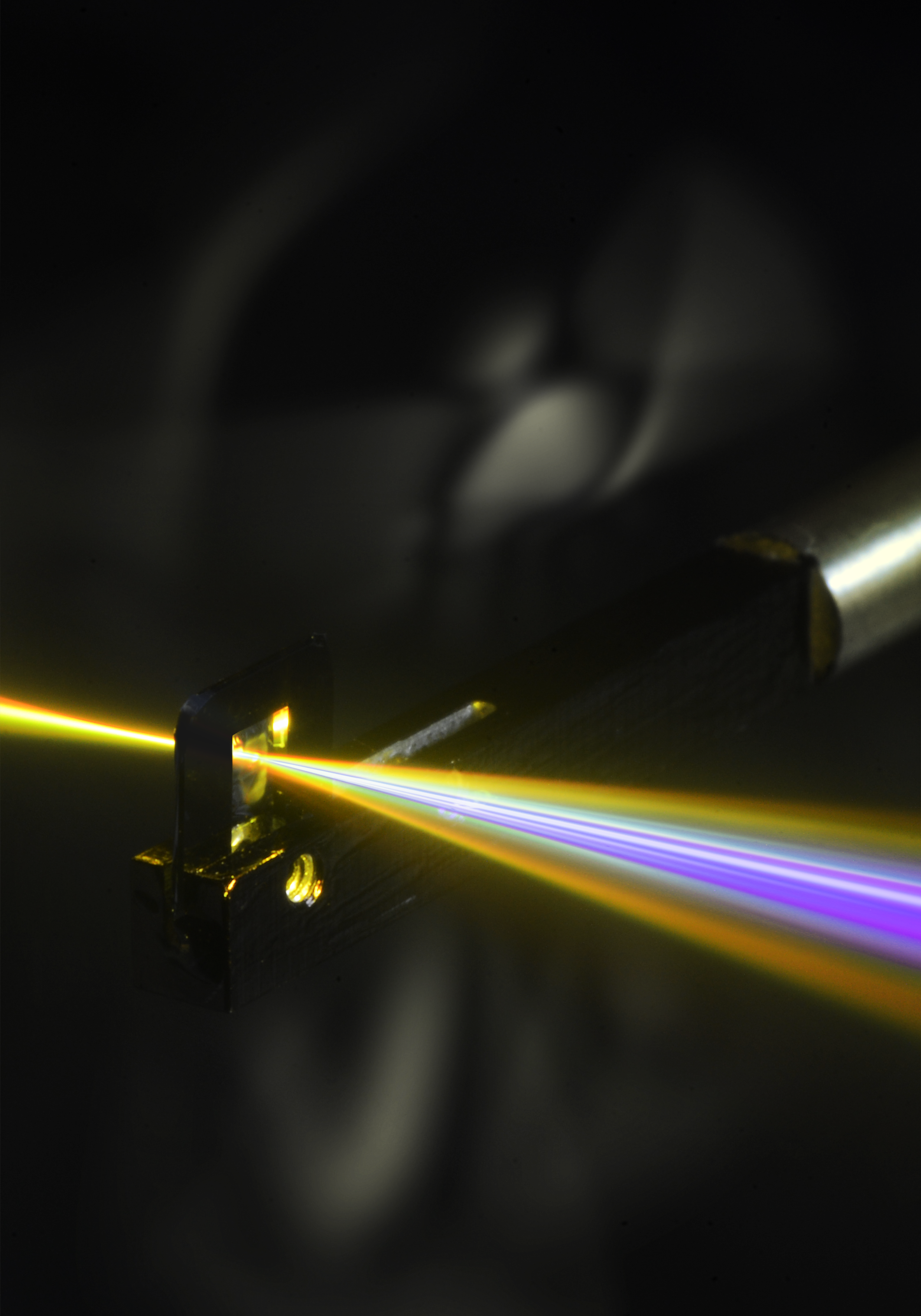
Our research program focuses on the dynamic visualisation of ultrafast electronic processes of matter with light. To this end, we develop and utilise intense, ultrashort, laser pulses whose field-waveform is controlled with sub-cycle precision. Under such fields, the interaction of laser and matter becomes extremely nonlinear and offers the possibility to devise new methodologies of probing the fundamental properties of electrons in a wide range of materials, ranging from atoms to complex solids. Understanding and controlling the microcosm at the level of electrons may become essential in future photonic and electronic technologies whose building blocks' size is gradually reducing from the mesoscopic to the atomic and molecular scales.
News
Zekun Pi defends PhD
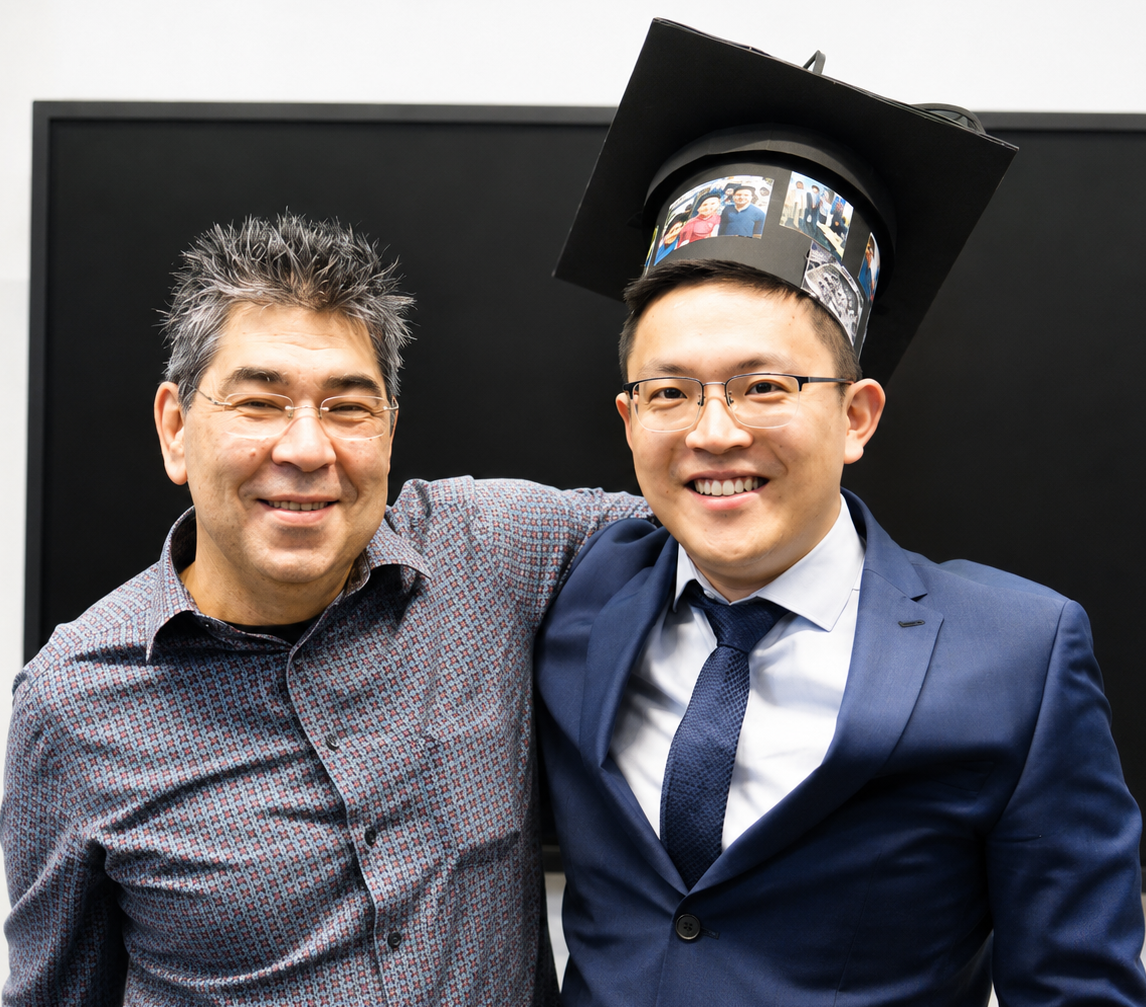
Rostock, Germany: Zekun Pi defended his PhD thesis - Synthesis and vectorial characterization of ultrafast light transients
The Xtreme Photonics Labs (XPL) group is proud to announce that Zekun has successfully defended his PhD thesis, marking a major milestone in the pursuit of ever-shorter, ever-more-controllable pulses of light.
His work tackles a key limitation of ytterbium-doped potassium gadolinium tungstate (Yb:KGW) lasers: while attractive for their scalability, high repetition rates, and lower cost compared to Ti:Sapphire systems, their pulses — typically ~100 fs — have been too long for strong-field and attosecond science. Using a neon-filled hollow-core fiber, Zekun achieved spectral broadening exceeding one petahertz, compressing pulses from 170 fs down to 8 fs, and ultimately to waveform-controlled single-cycle pulses of just 3.2 fs directly from a Yb:KGW amplifier.
Extending this approach, a dual-fiber module generated a supercontinuum spanning over 3.5 octaves (170–1900 nm). Coherently synthesizing these spectral channels, Zekun produced pulses as short as 1.8 fs with carrier-envelope-phase stabilization and a 600 as intensity envelope. Using two-dimensional homochromatic attosecond streaking, he then fully characterized the temporal evolution of these vectorial light fields with attosecond resolution.
This work establishes Yb:KGW-based systems as a compact, cost-effective platform for petahertz-scale spectral synthesis and attosecond field sampling.
Congratulations, Zekun on this excellent achievement!
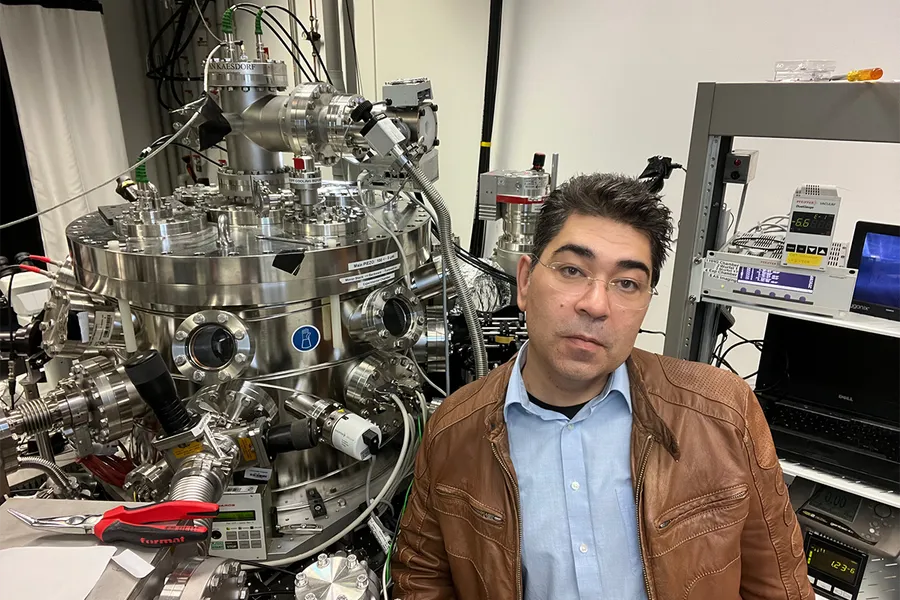
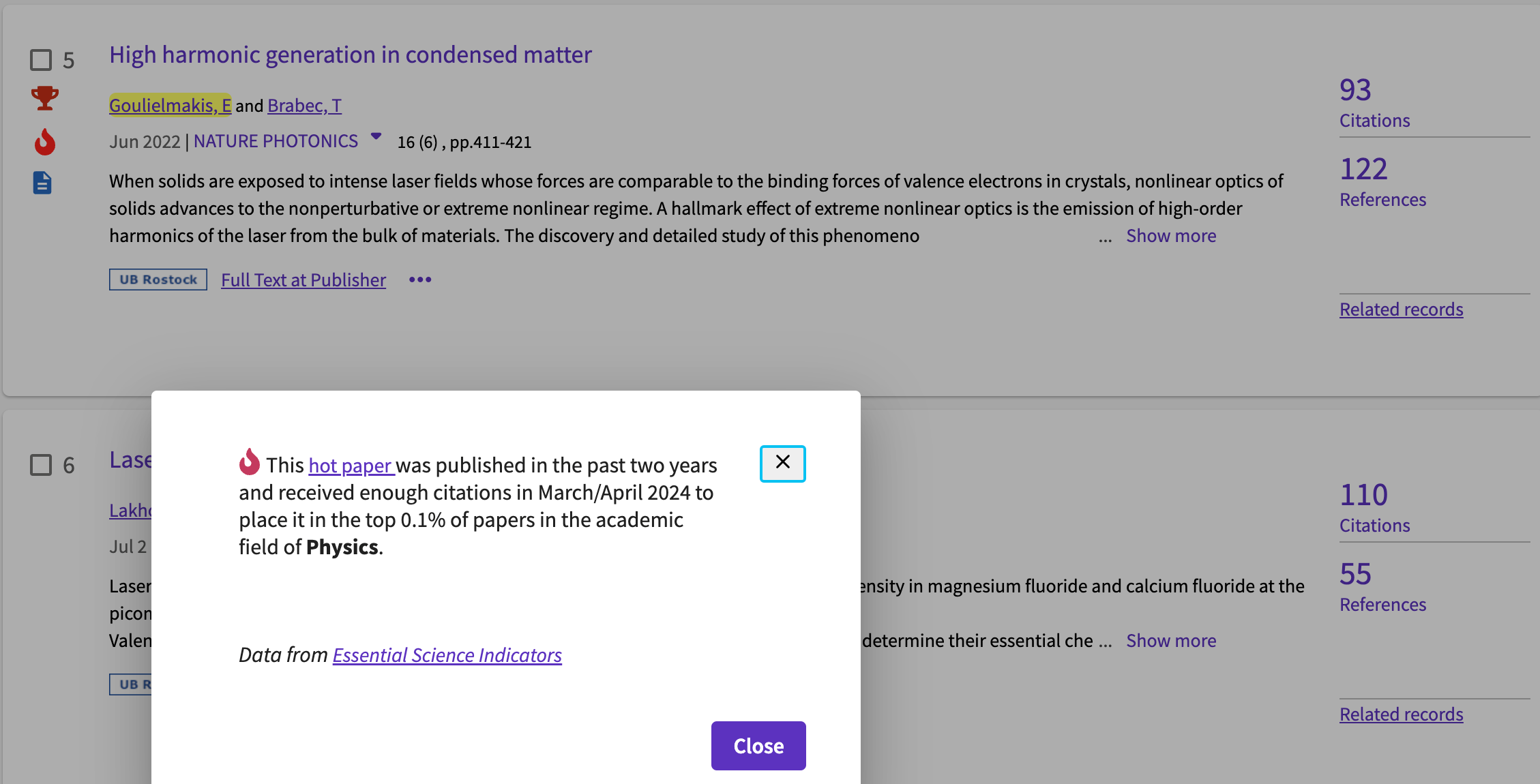
The Physicist from Crete Who Excels Internationally
Mister Pi und der 2,5-Millionen-Preis
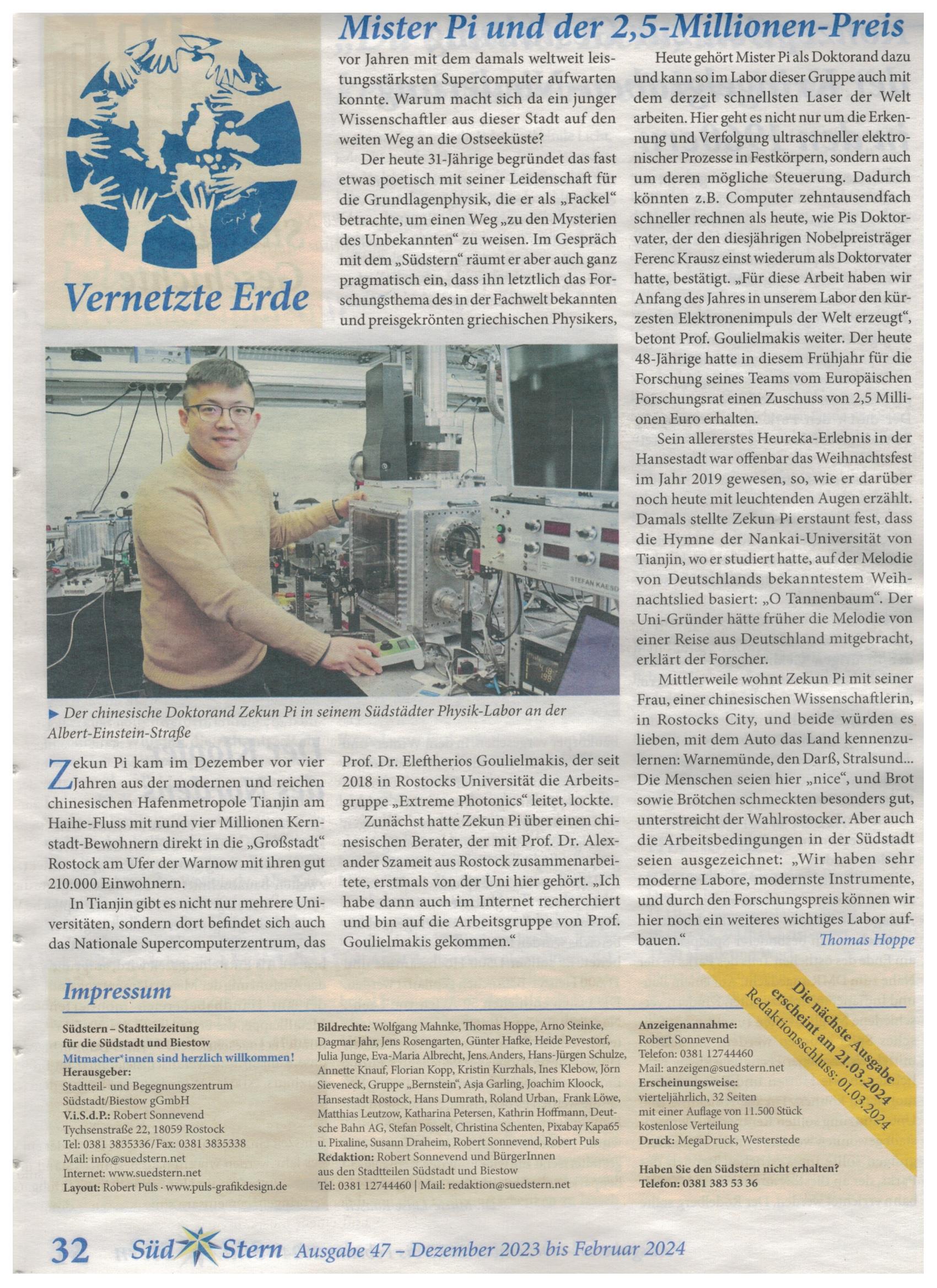
(Click on the image to view the Süd Stern newspaper report)